The Matter of the Past: Excavating Ruins in Ourém
There is a certain time in the morning, when the ground is still cold with dew, when the spade hits stone and the sound changes. It is not the dry sound of a concrete slab nor the impact against a loose rock. It is another sound — deeper, surer — that of a stone placed there by someone, with intention, long before any of our memories reach.
That is how, two weeks ago, the first clearing campaign of the site in Ourém began. The project asked for a new courtyard. The soil had other plans.
What the earth was keeping
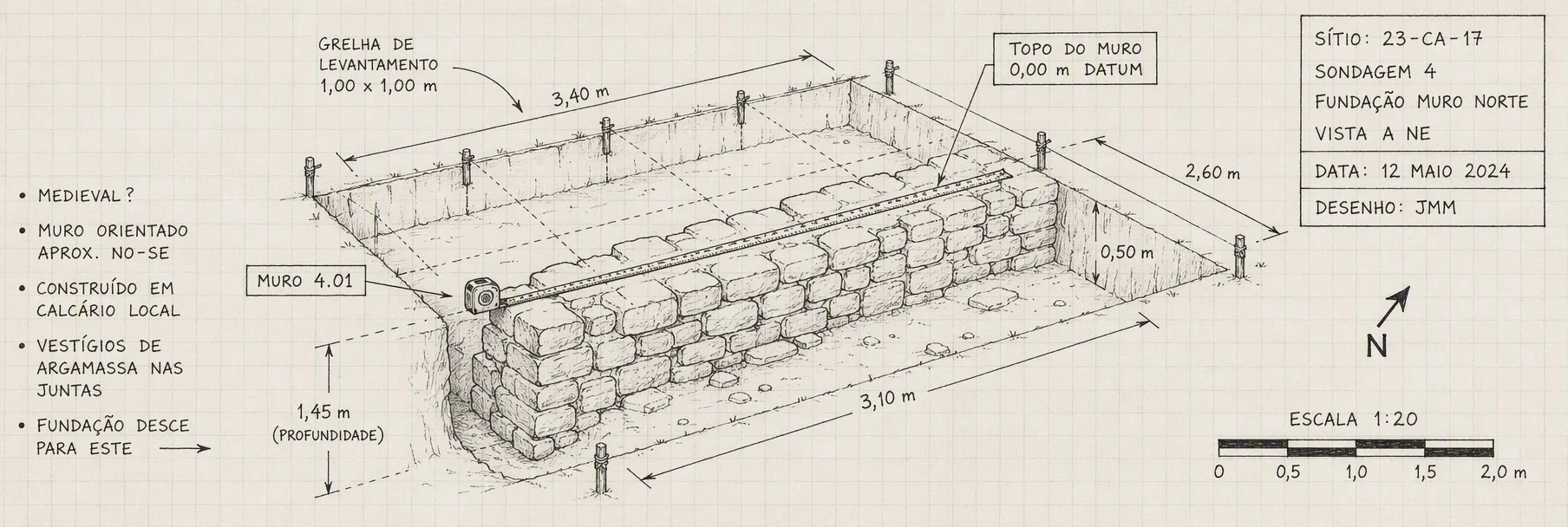
It took only forty centimetres of excavation for the ground's profile to begin telling a different story from the one in the initial project. An irregular, continuous line of stone running diagonally beneath what would be the southern corner of the courtyard. Then another, perpendicular. A meeting. A right angle that no erosion makes on its own.
Stonework. Irregular coursing, local stone, no visible mortar in the deepest courses — laid by weight and wedge, the old way, in which each stone chooses its place before receiving it. We do not yet know, with documentary certainty, which century it belongs to. Working hypotheses point to a late-medieval base, possibly associated with the agricultural annexes that the area's oral memory still attributes to the castle. What we do know, with all the certainty the hand gives the eye, is that someone measured this ground before us — only without a set square, without a laser, and with a patience that today is almost lost.
Drawing before touching
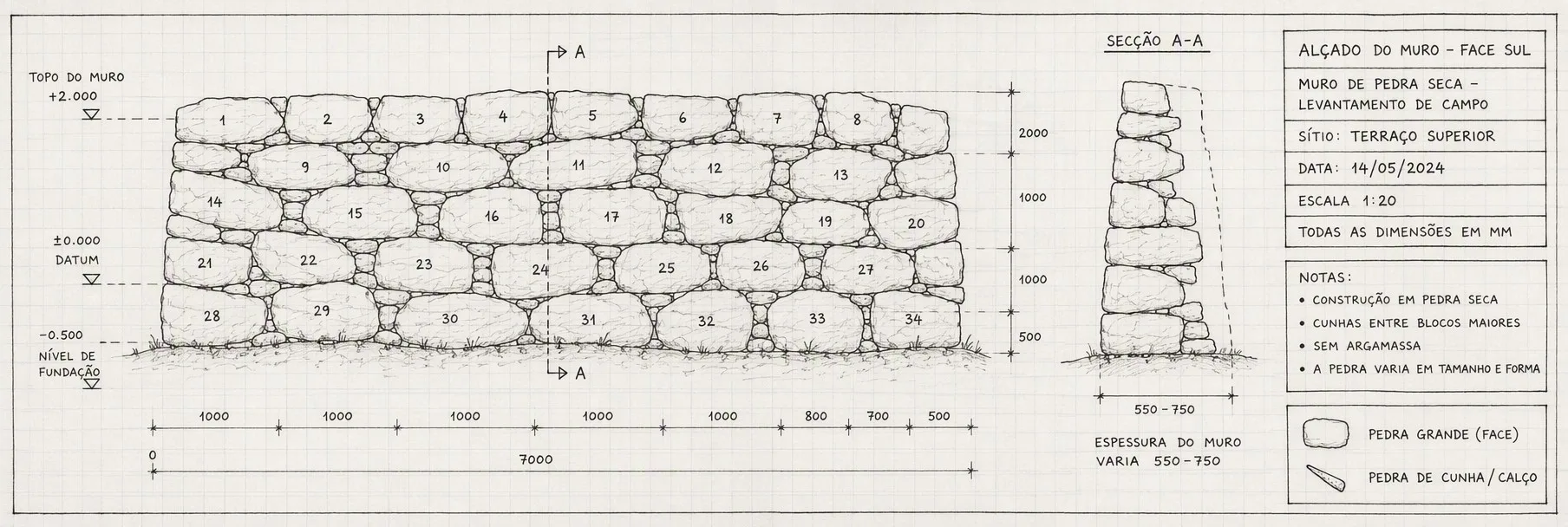
The first rule in any intervention on pre-existing structures is simple to state and hard to follow: nothing is decided before everything is drawn. We spent the first days not excavating, but recording — stone by stone, course by course, with a tape measure, a plumb line and a notebook that no longer leaves my hands. Each stone has its own texture, an angle of dressing, a way of sitting that tells where it came from and how it was worked.
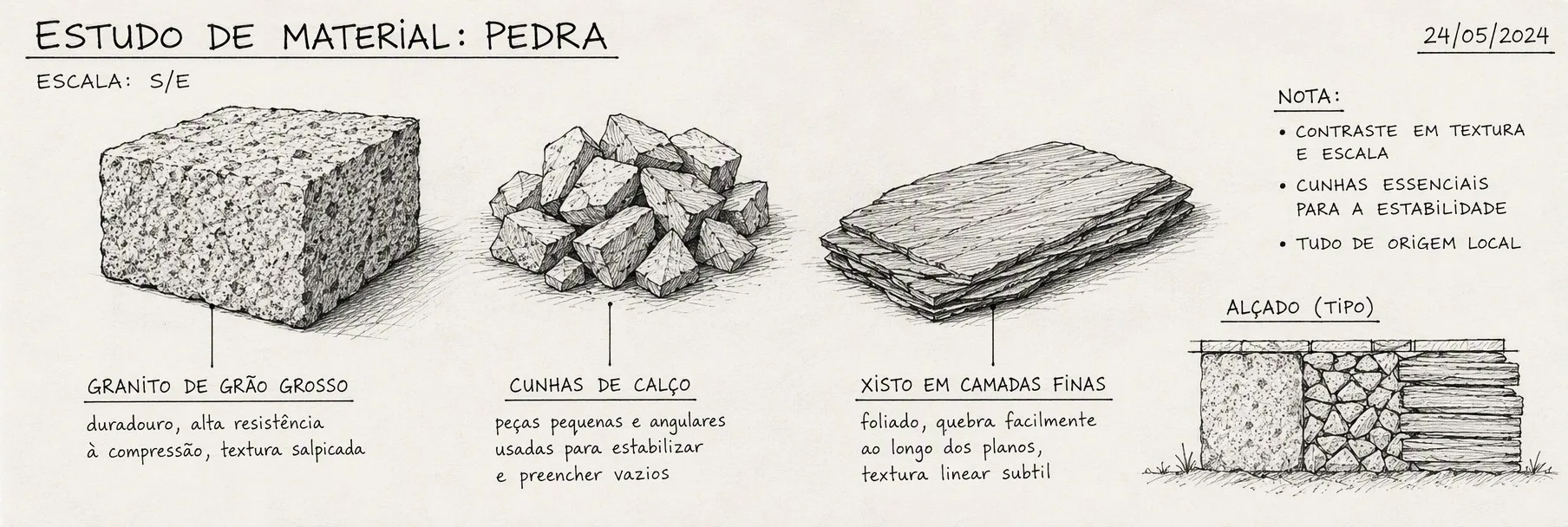
We studied three samples with particular attention: a local granite, coarse-grained, used in the courses bearing the most load; a finer slate, for reinforcement, filling the interstices; and the small packing wedges, almost always forgotten in rushed surveys, which are in practice what holds everything else in place.
 This kind of survey cannot be rushed. Every hour spent drawing a stone is an hour spent learning the logic of whoever placed it there — and it is that logic, more than any aesthetic inspiration, that ends up governing the design of what comes next.
The courtyard that respects what it found
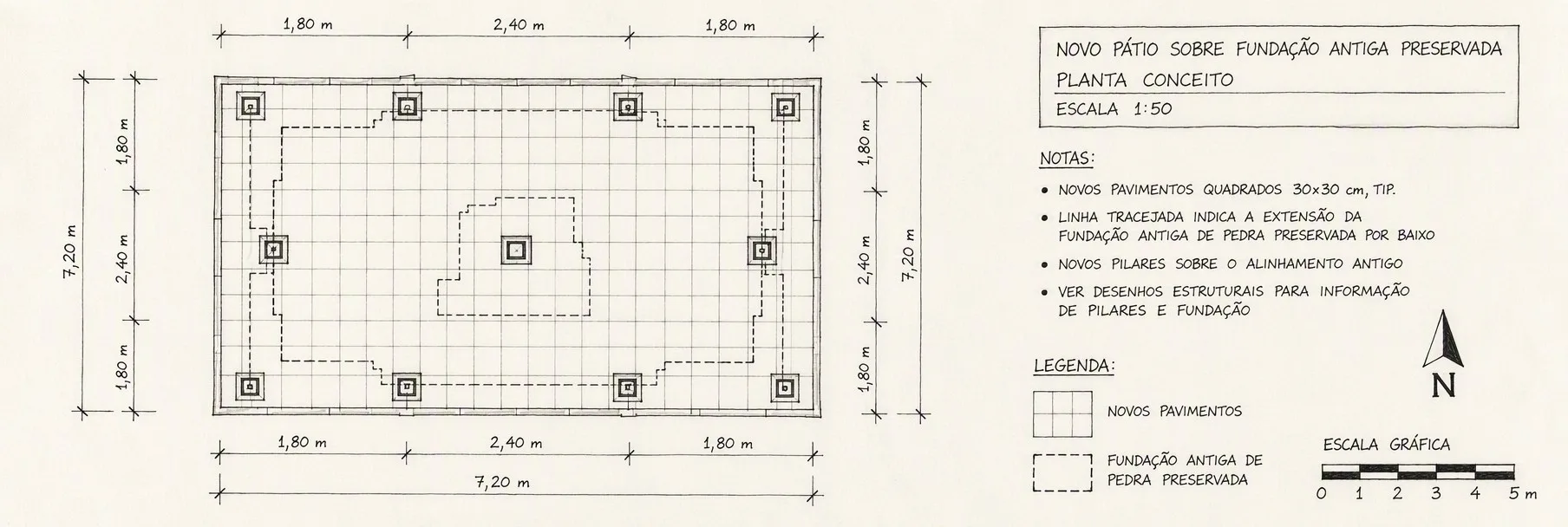
The most important decision in this project was not architectural in the conventional sense — it was a decision of attitude. We could have documented the foundation, photographed everything, and then covered it up, as if it had never been there. That is the fastest path, and sometimes the only possible one. But here the stonework was in good condition, the alignment was clear, and there was a rare opportunity: to let the design of the new courtyard be born directly from the old design.
The result is a contemporary pavement whose grid follows, without ambiguity, the alignments of the 14th-century stone — with a stretch of the original foundation kept visible, slightly recessed, like a scar one decides not to hide. The new pillars rest on the same axes that the old stonework had already established. It is not decorative homage. It is recognising that the ground already had a geometry, and that the most honest architecture is often the one that listens before it imposes.
Matter, space, time
I write this still with soil under my nails, because that is how this kind of work is done — not at the distance of a drawing board, but on my knees, next to the stone. There is a strange privilege in being the first person in several generations to touch a wall that another hand closed six hundred years ago and to decide, with all the care that deserves, what happens to it next.
A courtyard is not just an outdoor space between walls. It is, also, a layer of time we choose to leave visible. In Ourém, that layer was already there. Our job was simply to know how to see it — and not to be in a hurry to cover it again.
Are you interested in a renovation project with archaeological or heritage pre-existing features? Talk to me before you decide what to do with what the earth keeps.