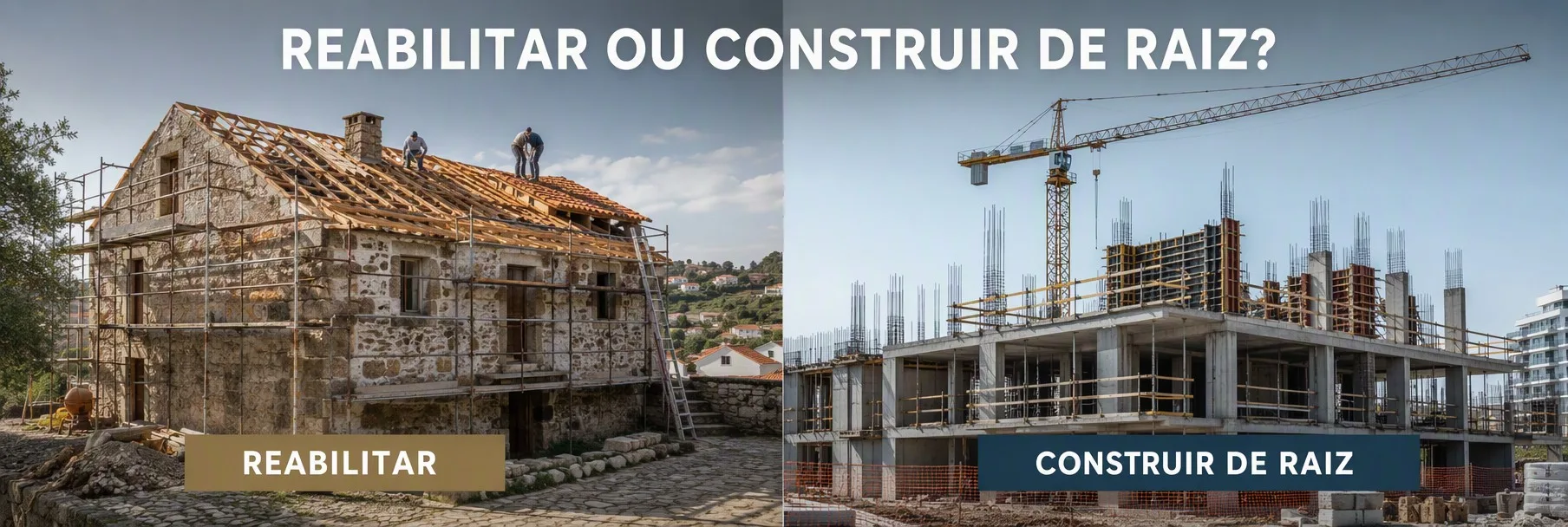
Renovate or Build from Scratch: Which Is Cheaper?
If there's one question I hear at practically every first meeting, it's this:
"Is it worth recovering the house I already have, or tearing everything down and building anew?"
The short answer is the one no one wants to hear: it depends. The long answer is the rest of this article — with real 2026 figures, the factors that change the math, and a practical case of a farmhouse in the countryside where that decision alone was worth tens of thousands of euros.
The numbers no one gives you upfront
Let's get straight to the market values in Portugal for 2026.
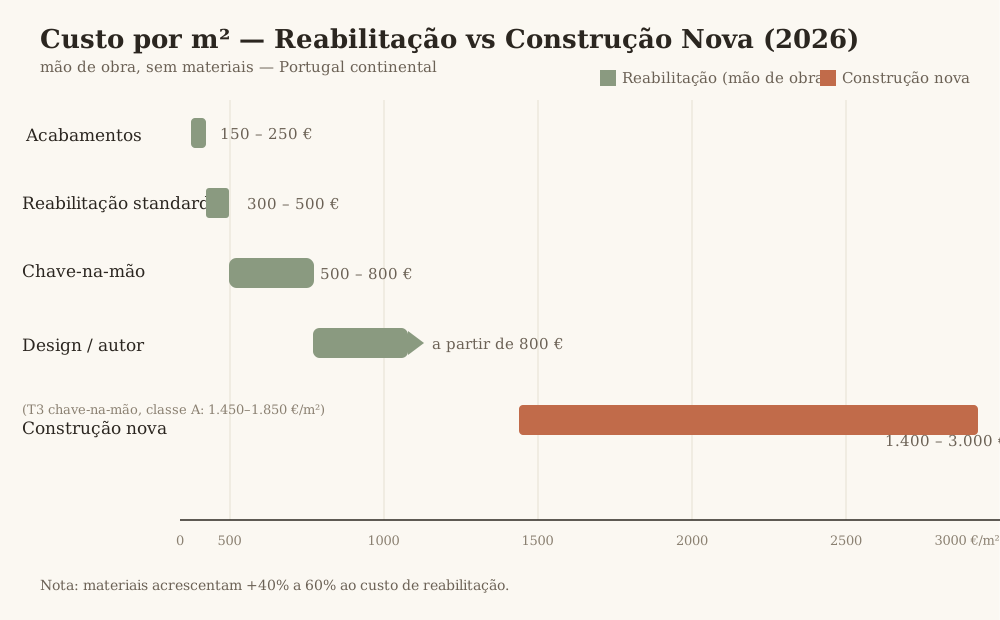
New construction, in reinforced concrete, standard range: between €1,400 and €3,000/m². For a turnkey 3-bedroom house, energy class A, the most realistic range sits around €1,450 to €1,850/m² of gross construction area. And there's a detail that tends to be missing from initial budgets: the final "ready to live in" value typically ends up 25 to 40% above the initial estimate.
Renovation varies more depending on the level of finishing:
| Level of intervention | Labour (€/m²) |
|---|---|
| Finishes (paint, surfaces) | €150 – €250 |
| Standard | €300 – €500 |
| Turnkey | €500 – €800 |
| Design / architect | from €800 |
Important note: these figures are for labour only. Materials add another 40 to 60% to the total budget.
In practice, a full renovation usually costs between 70% and 90% of the cost of an equivalent new build. But beware — it can easily exceed 100% in highly degraded buildings or those with heritage constraints (DGPC). And if the property predates 1950, expect an average increase of +35% because of obsolete infrastructure hidden behind the walls.
The advantage many people forget: VAT
Here's a fact that changes the numbers all on its own. Works on renovation, remodelling, restoration or conservation of residential buildings benefit from a reduced VAT rate of 6%, instead of the usual 23% — and this applies even outside Urban Rehabilitation Areas (ARU). On a €150,000 job, that rate difference alone is worth more than €25,000. It is almost always the deciding argument when the cost per m² is close.
Deadlines: the variable nobody calculates but everyone feels
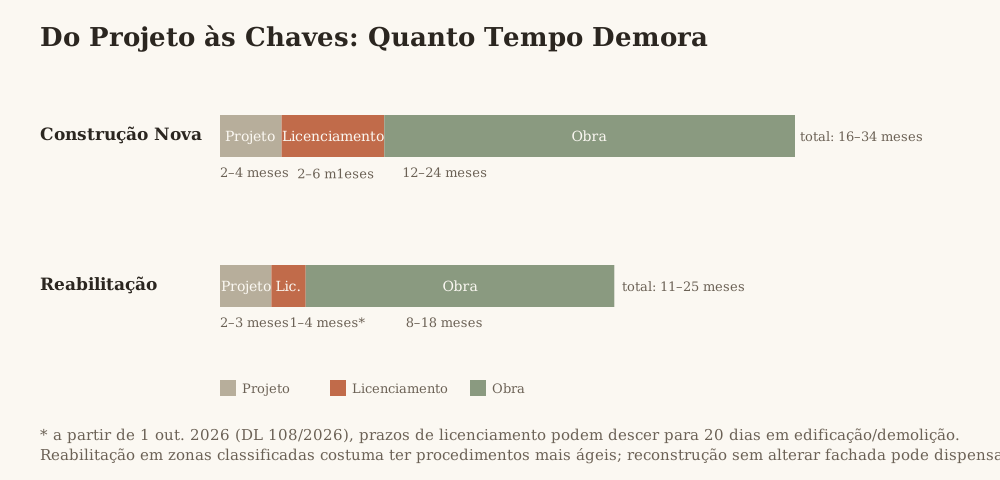
Money is half the problem. The other half is time.
In 2026, municipal decision deadlines are 120 days for works up to 300 m², 150 days between 300 and 2,200 m², and 200 days for larger interventions. This changes as of 1 October 2026, with Decree-Law 108/2026: deadlines are shortened to 20 days for building and demolition works, with tacit approval if the council fails to respond in time.
For a new build, the realistic time from start to finish — design, licensing and construction — usually runs between 18 and 36 months. Renovations in classified areas or historic centres tend to benefit from faster procedures, and there's a recent relevant change: rebuilding without altering the façade no longer requires licensing in many cases.
Practical case: the farmhouse in the countryside
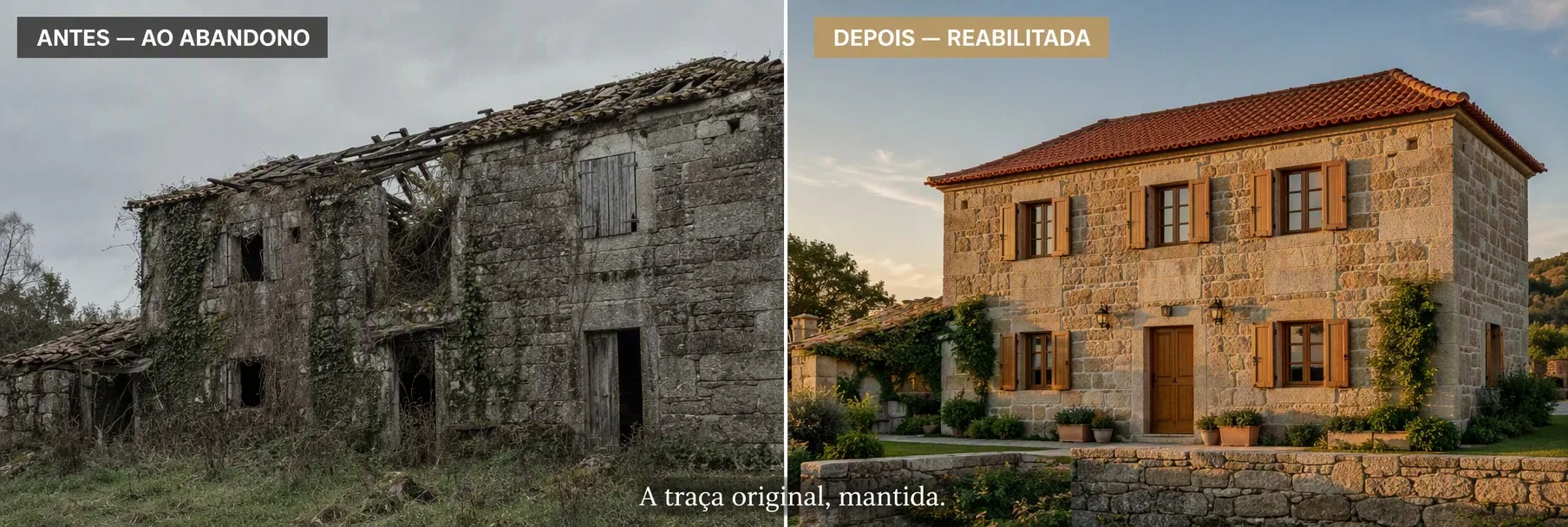
A client came to me with an early 20th-century farmhouse in the interior of the country, inherited and abandoned for nearly twenty years. Stone walls in good structural condition, but a collapsed roof, completely obsolete electrical and plumbing systems, and an outbuilding with no viability for recovery whatsoever.
The first reaction was "let's tear it all down and build from scratch — it's simpler." Before deciding anything, we carried out a feasibility study: a survey of the building's real condition, cross-referenced with renovation vs. new-build costs for the typology and location, and a simulation of the applicable VAT for each scenario.
The result:
- Renovating the main body (stone) came to about 78% of the cost of an equivalent new build, even with the surcharge for being a pre-1950 building.
- The 6% VAT on renovation represented savings of more than €30,000 compared with the new-build regime.
- The outbuilding, on the other hand, had no structural viability — it was demolished and rebuilt from scratch, isolated from the rest of the analysis.
- Combined result: the client saved around 22% of the total budget compared with the "tear everything down" scenario, and kept the historical and architectural value of the main house — something that has no price tag.
This is the kind of decision that isn't made "by eye." This is precisely what a feasibility study is for, before the first stroke of the design.
So, what's cheaper?
A rule of thumb, but never definitive:
Renovating tends to pay off when the structure is in good condition, the property has architectural value or is in a classified area, and the reduced VAT comes into the equation. Building from scratch tends to pay off when the degradation is such that renovation would exceed 90-100% of the cost of a new build, when you're seeking maximum energy efficiency without compromises, or when the land allows a clearly better layout than the existing one.
Between these two extremes lie most real cases — and that's where a well-done feasibility study pays for itself, often several times over.
Are you considering renovating or building from scratch and want concrete figures for your case? Get in touch with me to carry out a feasibility study.
Sources consulted:
- Remodelação vs. Construção Nova 2026 — Spacelovers
- IMI 2026: valor da construção sobe para 570 euros por m² — Idealista
- Quanto custa construir uma casa em Portugal (2026)? — engIobra
- Quanto custa construir um prédio em Portugal em 2026? — engIobra
- Preço Construção m² Portugal 2026 — Varandas Coelho
- Licenças de Obras em Portugal: o Que Precisa de Saber em 2026 — Ferreira Obras
- DL 108/2026: o que muda no licenciamento a partir de 1 de outubro de 2026 — Certiamb
- Reabilitar e construir casas sem licença chega em setembro — ECO
- Prazos de Licenciamento Municipal — AC Arquitetos